Dolly
Dolly was the first mammal cloned from an adult cell, and not the first cloned mammal
The Roslin Institute’s own history is the spine of this page. The Science Museum Group holds the jumper and the electrofusion machine, and tells those objects’ stories in its own words. The photograph on this site was taken in 2017, long after Dolly’s death.
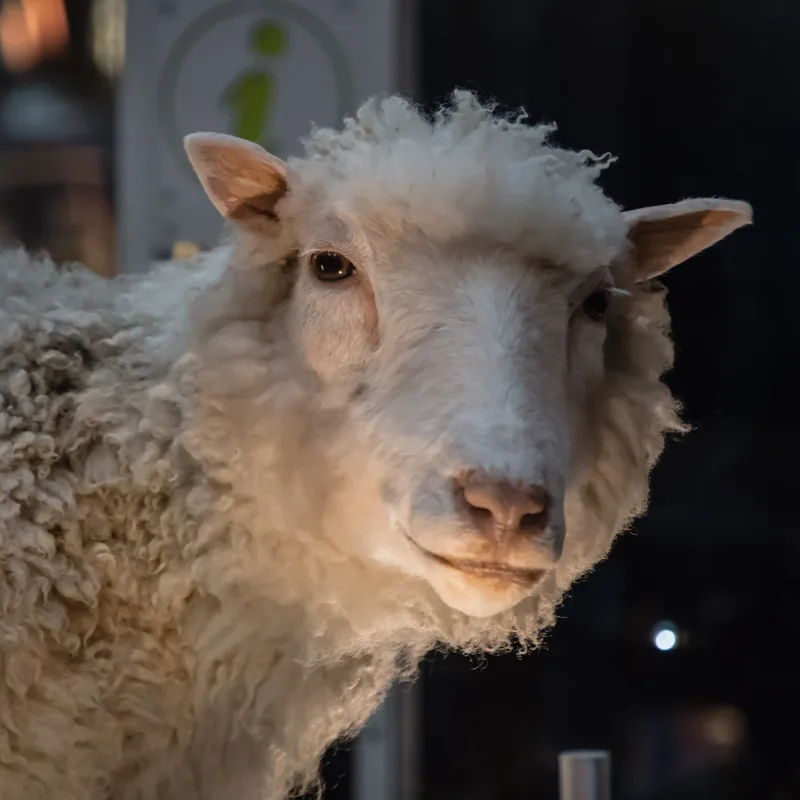
The photograph is by london road, taken on 26 January 2017. The Commons description calls her “Dolly the Sheep: the first mammal cloned from an adult cell 1996 (died 2003) at the Roslin Institute.” The Roslin Institute’s history says that after her death “the Roslin Institute donated Dolly’s body to the National Museum of Scotland in Edinburgh, where she has become one of the museum’s most popular exhibits.” This is a later photograph of the preserved animal. The Commons line is not treated here as a correction of the Institute. [source]
How she was made, in official wording
“Dolly was created as a result of an experiment at the Roslin Institute.” The experiment “formed part of a study that aimed to improve methods of producing genetically modified livestock.” “If successful, the study would mean fewer animals would need to be used in this area of work.” The experiments “were carried out at the Roslin Institute and PPL Therapeutics by a team led by Professor Sir Ian Wilmut,” “made up of people with a range of skillsets, including scientists, embryologists, surgeons, vets and farm staff.” [source]
“Dolly was cloned from a cell taken from the mammary gland of a six-year-old Finn Dorset sheep and an egg cell taken from a Scottish Blackface sheep. She was born to her Scottish Blackface surrogate mother on 5 July 1996. Dolly’s white face was one of the first signs that she was a clone because if she had been genetically related to her surrogate mother, she would have had a black face. Dolly was named after the country music singer Dolly Parton.” [source]
The Science Museum Group, describing the electrofusion apparatus used at Roslin, says: “Dolly the sheep was the first mammal cloned from an adult cell. The cloning process was jump-started using a pulse from this electrofusion machine at the Roslin Institute in Scotland. Dolly was created by taking the DNA from an adult sheep’s mammary cell which was then inserted into a DNA-free egg.” [source]
First, but not first
“Dolly was the first mammal to be cloned from an adult cell. Her birth proved that specialised cells could be used to create an exact copy of the animal they came from.” “However, Dolly was not the first ever cloned mammal. That honour belongs to another sheep which was cloned from an embryo cell and born in 1984 in Cambridge, UK. Two other sheep, Megan and Morag, had also been cloned from embryonic cells grown in the lab at the Roslin Institute in 1995 and a further six sheep, cloned from embryonic and foetal cells, were born at Roslin at the same time as Dolly. What made Dolly so special was that she had been made from an adult cell, which no-one at the time thought was possible.” [source]
The announcement
“Dolly was announced to the world on 22 February 1997, to a frenzy of media attention. The Roslin team chose to make the announcement at this time to coincide with the publication of the scientific paper which describes the experiments that produced her.” “In the week following the announcement, the Roslin Institute received 3,000 phone calls from around the world.” [source]
A life at Roslin
“Dolly spent her life at the Roslin Institute and, apart from the occasional media appearance, led a normal existence with the other sheep at the Institute. Over the years, Dolly had a total of six lambs with a Welsh Mountain ram called David. Their first lamb, Bonnie, was born in April 1998.” [source]
“When Dolly was a year old, analysis of her DNA showed that her telomeres — caps on the ends of DNA molecules that protect them from damage — were shorter than would be expected for a normal sheep of the same age.” “It was thought that, because Dolly’s DNA came from an adult sheep, her telomeres had not been fully renewed during her development. This could have meant that Dolly was biologically older than her actual age. However, extensive health screens on Dolly at the time did not find any conditions which could be directly related to premature or accelerated ageing.” [source]
“In 2001, Dolly was diagnosed with arthritis after farm staff noticed her walking stiffly. This was successfully treated with anti-inflammatory medication, although the cause of the arthritis was never discovered.” “After Dolly gave birth to her last lambs in September 2000, it was discovered that she had become infected by a virus called Jaagsiekte sheep retrovirus (JSRV), which causes lung cancer in sheep. Other sheep at the Roslin Institute had also been infected with JSRV in the same outbreak.” [source]
“Dolly continued to have a normal quality of life until February 2003, when she developed a cough. A CT scan showed tumours growing in her lungs and the decision was made to euthanise Dolly rather than risk her suffering. Dolly was put to sleep on 14 February 2003, at the age of six.” “After her death the Roslin Institute donated Dolly’s body to the National Museum of Scotland in Edinburgh.” [source]
The Science Museum Group’s object history for the jumper uses a shorter official sentence: “Dolly was put down on 14 February 2003 when aged six after having a progressive lung disease.” That is museum wording, kept here beside the Institute’s longer account, not as a replacement for it. [source]
The jumper
The Science Museum Group holds a wool jumper “knitted from the first fleece of the sheep named ‘Dolly’ which was the first animal to be born as a result of cloning an adult cell, design Holly Wharton, by the winner of a competition ‘Do a Design for Dolly’ and made by Steve Melia, at the School of Textiles, Leeds University, 1997.” “After Dolly’s shear, 2.7kg of her fleece was donated to the Cystic Fibrosis Trust to raise funds for research.” [source]
What Roslin says now
The Cloning FAQs ask, “Does the Roslin Institute still clone animals?” The official answer is: “We do not clone animals any more. The technique has a very low success rate — Dolly was the result of many months of research involving a highly skilled team. In the years since Dolly was born, new technologies have been developed, which are vastly more efficient than cloning. However, we still use the skills and experience we gained while working on Dolly in our work with livestock animals today.” “Cloned embryos are more likely to be lost during pregnancy than normal embryos, which accounts for the low success rate of cloning.” [source]
Keep exploring
Enjoyed the flock?
No pop-ups. No intrusive advertising. Just interesting stuff. A little support helps the next farmyard site get built.