Discoveries
Things you may never have been told about sheep
A white face that proved a clone, a jumper from a first fleece, an Institute that no longer clones animals, and a rounded official number that belongs to two different kinds of sheep. Each story is still attached to its source.
Named after Dolly Parton
The Roslin Institute’s own wording is the best one: “Dolly was named after the country music singer Dolly Parton.” She was cloned from a mammary cell of a six-year-old Finn Dorset, which is how the name arrived. [source]
A white face was one of the first signs
Dolly “was cloned from a cell taken from the mammary gland of a six-year-old Finn Dorset sheep and an egg cell taken from a Scottish Blackface sheep,” and “born to her Scottish Blackface surrogate mother on 5 July 1996.” “Dolly’s white face was one of the first signs that she was a clone because if she had been genetically related to her surrogate mother, she would have had a black face.” [source]
She was not the first cloned mammal
The Institute is explicit, and the distinction is the whole wonder of her: “Dolly was the first mammal to be cloned from an adult cell.” She “was not the first ever cloned mammal. That honour belongs to another sheep which was cloned from an embryo cell and born in 1984 in Cambridge, UK.” Megan and Morag were cloned at Roslin in 1995, and six more sheep “cloned from embryonic and foetal cells, were born at Roslin at the same time as Dolly.” What made her special “was that she had been made from an adult cell, which no-one at the time thought was possible.” [source]
A jumper from the first fleece
The Science Museum Group describes a wool jumper “made from the first fleece of ‘Dolly’,” designed by Holly Wharton, “by the winner of a competition ‘Do a Design for Dolly’ and made by Steve Melia, at the School of Textiles, Leeds University, 1997.” After her shear, “2.7kg of her fleece was donated to the Cystic Fibrosis Trust to raise funds for research.” [source]
An electrofusion pulse jump-started the process
The Science Museum Group’s catalogue for object 1998-797 says the cloning process “was jump-started using a pulse from this electrofusion machine at the Roslin Institute in Scotland,” after “the DNA from an adult sheep’s mammary cell” was “inserted into a DNA-free egg.” [source]
Roslin no longer clones animals
Ask the Institute’s Cloning FAQs “Does the Roslin Institute still clone animals?” and the answer is still: “We do not clone animals any more. The technique has a very low success rate — Dolly was the result of many months of research involving a highly skilled team.” “Cloned embryos are more likely to be lost during pregnancy than normal embryos, which accounts for the low success rate of cloning.” [source]
Shorter telomeres, and a later cough
When Dolly was a year old, “analysis of her DNA showed that her telomeres … were shorter than would be expected for a normal sheep of the same age.” “It was thought that, because Dolly’s DNA came from an adult sheep, her telomeres had not been fully renewed.” “However, extensive health screens on Dolly at the time did not find any conditions which could be directly related to premature or accelerated ageing.” She later developed arthritis, which was treated, and was found to have been infected with JSRV, “which causes lung cancer in sheep.” In February 2003 “she developed a cough. A CT scan showed tumours growing in her lungs.” She “was put to sleep on 14 February 2003, at the age of six.” [source]
14.8 million, used twice
The United Kingdom release for 1 June 2025 says the female breeding flock “decreased by 0.7% to 14.8 million,” and, in a separate sentence: “Lambs account for the majority of other sheep & lambs and decreased by 2.9% to 14.8 million.” The same rounded number, two different kinds of sheep. The official table behind those sentences is 14,779,632 in the breeding flock, 15,703,976 other sheep and lambs, and a total of 30,483,608. [source]
“Other sheep and lambs” is a wider column than lambs
Other sheep and lambs, in the official 2025 table, are 15,703,976, rounded in the accompanying sentence to 15.7 million. Lambs, the release says, “account for the majority of other sheep & lambs,” and in their own sentence “decreased by 2.9% to 14.8 million.” Majority, in other words, is not the whole flock in that column. [source]
A commercial holding starts at more than 20 sheep
The official England definition of a commercial holding includes holdings with “more than … 20 sheep.” Sheep figures in that release “relate to commercial holdings.” A smaller flock is a real flock. It is simply not in the survey that produces the England totals. [source]
Sheep and cattle are counted in different ways
In the same England livestock release, sheep figures come from the June Survey and relate to commercial holdings. Cattle figures come from the Cattle Tracing System and relate to all holdings. Two methods, printed on one official page. [source]
A mid-winter flock at The Saxhams
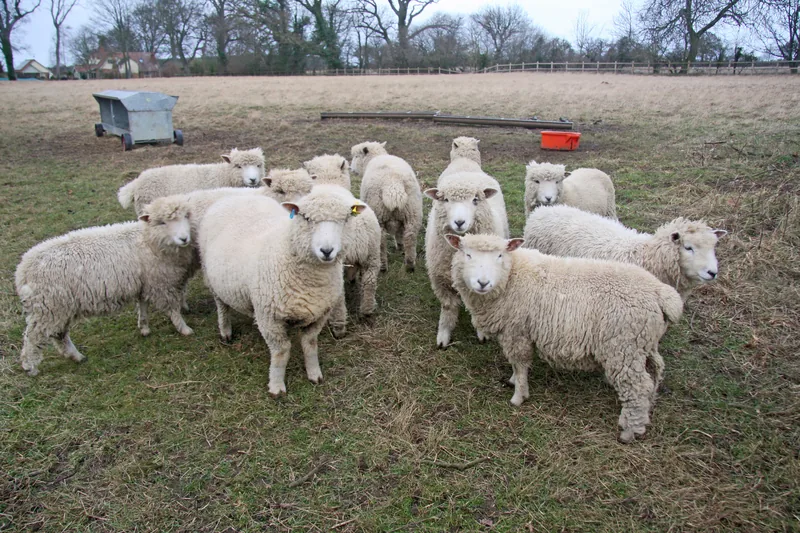
The photograph of a mid-winter flock at The Saxhams, Suffolk, is filed on Wikimedia Commons under the title “Ryedale,” and in a Commons category that says Ryeland. The picture is a real flock on a named day. The files do not settle the breed, and the photograph is not a June Survey line.
Keep exploring
Enjoyed the flock?
No pop-ups. No intrusive advertising. Just interesting stuff. A little support helps the next farmyard site get built.